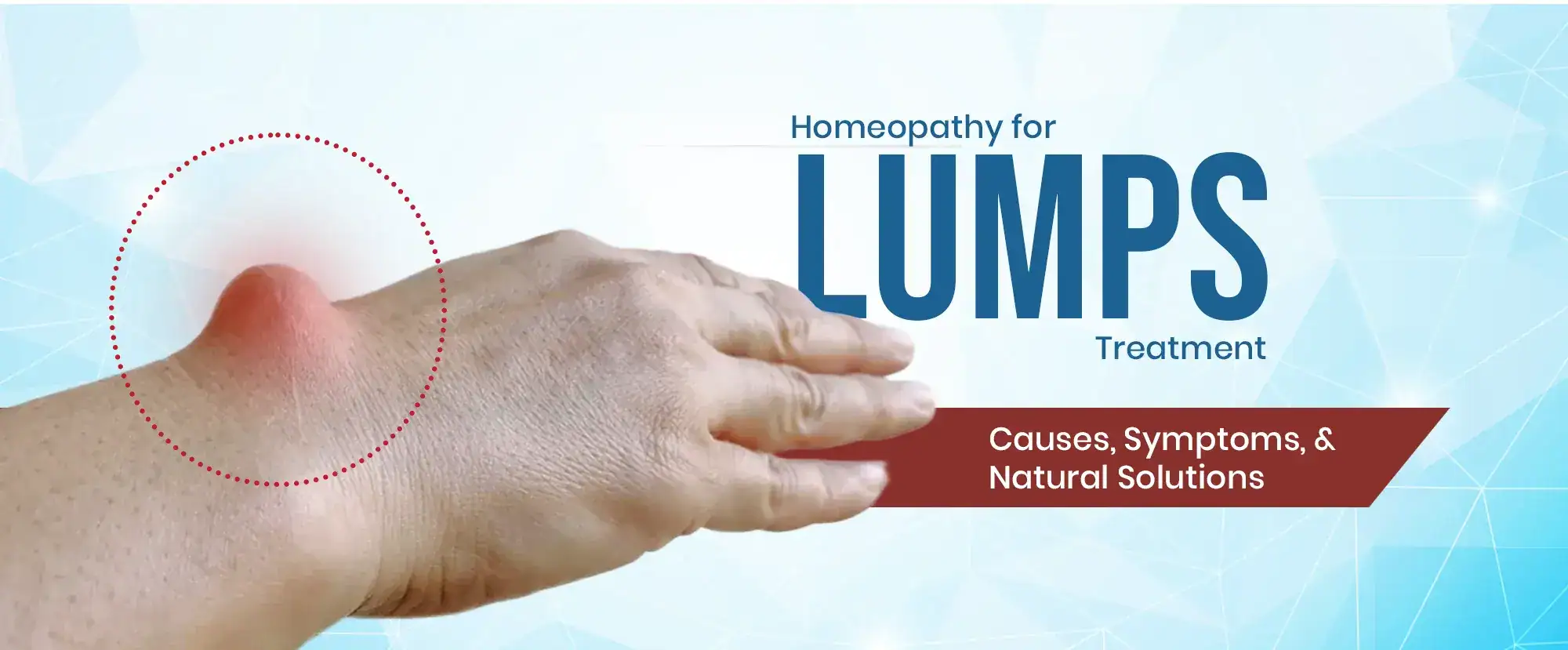
Homeopathy treatment for lumps offers a gentle, holistic approach that many people prefer today, especially when they are looking for natural and non-invasive care. It focuses not only on the visible swelling but also on the underlying causes such as inflammation, infection tendency, tissue changes, and overall body balance.
What Are Lumps?
A lump is a general term used to describe any abnormal swelling, bump, or localized enlargement in the body. Lumps can often be felt and sometimes seen, and they may appear anywhere on your body. The word “lump” commonly triggers fear of cancer, but most lumps are benign and non-cancerous, arising from conditions like infections, cysts, inflammation, trauma, or fluid accumulation.
Lumps may develop suddenly or grow slowly over time, and their size, shape, and feel can vary greatly. They can be soft or hard, painful or painless, and may move under the skin or remain fixed in one place. A lump may be as small as a pea or as large as a golf ball, and many people experience such lumps or skin growths at some point in their lives.
Most of these lumps are normal and harmless, appearing either under the skin or as growths hanging from the skin surface. Although many lumps are benign, it is important to seek medical advice if you feel worried or notice any changes. Many people now choose to combine modern medicine with holistic options like homeopathy because it offers gentle care and is widely preferred for long-term support.
What are the types of lumps?- Benign (Non-Cancerous) Lumps: These lumps are usually harmless and slow-growing. They often feel soft and can move under the skin. Common examples include lipomas, cysts, and fibromas.
- Inflammatory Lumps: Inflammatory lumps develop due to inflammation in the body. They may feel tender, warm, and swollen. Redness around the area is often present.
- Infectious Lumps: These lumps occur as a result of infections. They are often painful and swollen. Abscesses and enlarged lymph nodes are common examples.
- Cystic Lumps (Fluid-Filled): Cystic lumps are filled with fluid and usually feel smooth to touch. They are generally benign. Such lumps can form under the skin or within body tissues.
- Solid Lumps: Solid lumps are made of tissue rather than fluid. They often feel firm when touched. Depending on the cause, they may be benign or malignant.
- Malignant (Cancerous) Lumps: Malignant lumps are cancerous in nature. They are typically hard, irregular in shape, and painless. These lumps may be fixed to deeper tissues.
- Trauma-Related Lumps: Trauma-related lumps form after an injury. They are caused by blood collection under the skin or scar tissue. These lumps often reduce as the body heals.
- Cysts: These are fluid-filled sacs that form due to blocked glands or ducts. They are usually smooth and benign.
- Enlarged Lymph Nodes: Lymph nodes can swell during bacterial or viral infections. This commonly happens in the neck, armpits, or groin.
- Lipomas (Fatty Growths): Lipomas are soft, doughy lumps made of fatty tissue. They are painless and move easily under the skin.
- Abscesses: These are pockets of pus caused by infection. They are often painful, red, and warm to the touch.
- Fibroadenomas (Breast Lumps): These are benign breast lumps linked to hormonal changes. They may appear during menstrual cycles, pregnancy, or breastfeeding.
- Infections: These can cause boils, cellulitis, or inflamed lumps. Such lumps are usually tender and swollen.
- Hormonal Changes: Hormonal fluctuations can lead to lump formation, especially in breast tissue. These lumps are often benign.
- Injuries or Trauma: Injury can cause blood to collect under the skin, forming a hematoma. These lumps often appear suddenly after impact.
- Tumours (Benign or Malignant): Tumours can form in tissues or organs such as the breast, thyroid, or liver. Benign tumours are harmless, while malignant tumors are cancerous and may feel hard, fixed, and painless.
- Grows rapidly or changes shape
- Lasts for more than 2–3 weeks
- Becomes hard, fixed, or painful
- Comes back after being removed
- Is red, hot, or swollen
- Is associated with fever or chills
- Is associated with unexplained weight loss
- Has skin changes or discharge
- Appears in the breast or testicles
- Causes difficulty in swallowing, breathing, or movement
- Causes swelling in the neck, armpit, or groin that does not reduce within 2 weeks
- Medical History and Physical Examination: The doctor examines the lump by looking and feeling it. They assess its size, shape, texture, and whether it moves under the skin. Nearby lymph nodes are also checked. You may be asked when the lump appeared, if it has changed, and if you have symptoms like pain, fever, or weight loss. Personal and family medical history is also discussed.
- Blood Tests: Blood tests may be ordered to find the signs of infection, inflammation, or other underlying conditions.
- Ultrasound Scan: An ultrasound uses sound waves to create images of the lump. It helps determine whether the lump is fluid-filled or solid.
- Mammography: This imaging test is used specifically for breast lumps. It helps detect abnormal changes in breast tissue.
- CT Scan or MRI: These scans provide detailed images of internal tissues. They help identify the exact location of the lump and its relation to nearby structures.
- Biopsy or Fine-Needle Aspiration: A small sample of tissue or fluid is taken from the lump. The sample is examined under a microscope to check for abnormal or cancerous cells. The method used depends on the lump’s characteristics.
Homeopathy Treatment for Lumps
Homeopathy treatment for lumps is increasingly chosen by people who prefer natural and gentle healing and seek lipoma treatment without surgery. Many individuals opt for homeopathy to manage lumps without invasive procedures. Homeopathy offers a holistic approach that looks beyond the lump itself and focuses on the underlying cause. Homeopathy treatment for lumps does not address only the physical swelling. It works on deeper factors such as inflammation, infection tendency, tissue changes, and overall body balance. Remedies are selected based on the type of lump, associated symptoms, and the person’s general health. Since homeopathy follows a personalised approach, treatment is tailored to each individual. Homeopathic medicines are natural and non-invasive. They aim to support the body’s self-healing ability and may help reduce discomfort, control progression, and improve overall well-being. NOTE: Homeopathy treatments are personalised. Do not take any homeopathy medicine without consulting a homeopathic doctor.Managing Lumps with Homeopathy treatment: Gentle, Effective Care at Dr. Care Homeopathy Clinics
At Dr. Care Homeopathy, we provide safe, natural, and holistic treatment for lumps by focusing on the root causes rather than just reducing the swelling. Our approach works on supporting the body’s self-healing, balancing tissue health, reducing inflammation, and improving overall immunity. Since every lump and individual is different, we create personalised treatment plans based on the type of lump, associated symptoms, emotional health, and medical history. Our remedies help manage common concerns such as painful or persistent lumps, cysts, swelling due to infection or trauma, and tissue irregularities, while promoting long-term health and balance. Treatment is gentle, non-invasive, and suitable for those seeking effective care without harsh side effects, making homeopathy a safe option for managing lumps naturally. With over 22 years of expertise in holistic healing, Dr. Care Homeopathy is trusted nationwide for delivering personalised care. Our experienced team and evidence-based homeopathic methods have helped millions of patients support overall health and improve their body’s natural ability to heal. What are some lifestyle measures that support Lumps healing? A few simple lifestyle habits can create a significant difference in supporting the body’s natural healing. Some simple but effective lifestyle changes include:- Maintain good hygiene to reduce infection risk
- Eat a balanced, nutrient-rich diet for tissue and immune health
- Stay well-hydrated to support overall body function
- Manage stress effectively to help the body heal naturally
- Avoid smoking and alcohol to protect tissue health
- Get adequate sleep to allow the body to repair and regenerate
- Do lumps go away on their own?
- How do I tell if a lump is cancerous?
- Are homeopathic remedies safe for lumps?
- How does homeopathy treat lumps?